Land and People
By Kübra Elmas
An agricultural engineer's perspective on a landscape shaped by centuries of farming
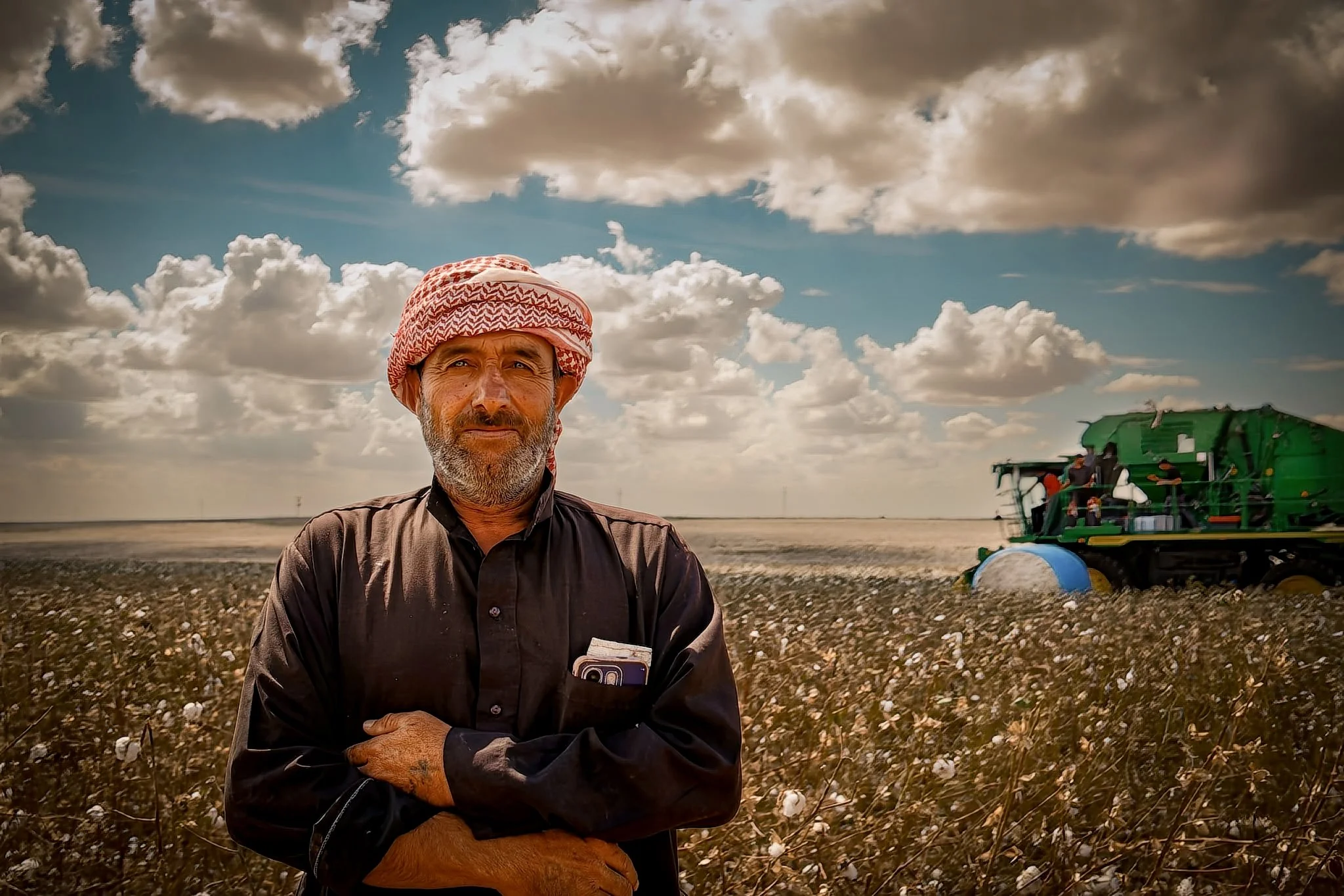
Dahham Abdullah manages irrigation across cotton fields in southeastern Türkiye, drawing on generations of agricultural knowledge, careful observation of soil conditions, and an understanding of the water needed to sustain each harvest. Photograph by Kübra Elmas
The land stretching between the Euphrates and Tigris is one of the earliest places where people began to cultivate the soil, produce food, and build settled lives. For me, though, before any of that history, it is simply the place where I live—a landscape I have long believed I knew.
Perhaps that is why my connection to this land is not always easy to describe. When we live within a landscape, we often begin to accept it as it is. The fields, the villages, the animals, the lives shaped around water, and the rhythm of production changing with the seasons all become part of the everyday. Agriculture taught me to look at this place differently. I began to see soil not simply as the ground beneath our feet, or as a surface from which we grow crops, but as a place where people have built their lives, accumulated knowledge, and left their mark across generations.
The time I have spent with farmers has also taught me that knowledge of the land does not exist only in books, analyses, or data. Sometimes it is held in the way a farmer takes a handful of soil and feels its moisture; in waiting for rain; in knowing where to lead the animals; or in understanding when the time has come to place a seed into the ground. Here, agriculture and animal husbandry are more than ways of producing food. They are the continuation of an ancient relationship between people and the place they inhabit.
Thousands of years ago, remaining in one place became possible through learning how to cultivate the soil, grow plants, live alongside animals, find and manage water, and follow the seasons. People did not simply place seeds into the earth; over time, they began to build their lives around it. Villages, paths, customs, ways of working, and knowledge passed from one generation to another all grew from this relationship.
The tools we use, the crops we grow, and the ways we farm may have changed. Yet when I move through this landscape, I sometimes feel that the essence of our relationship with the land remains much the same. We are still searching for water, following the seasons, and trying to understand what the soil will give us. The land continues to shape the boundaries of our lives.
When drought comes, it is not only the harvest that changes; people’s decisions change with it. When water becomes scarce, the consequences are felt not only in the fields, but also in livestock, livelihoods, and everyday life. When the soil becomes exhausted, its effects are visible not only in yields, but in the lives of the people who depend upon it.
But this relationship has never been one-sided. For thousands of years, people have also been changing the land. We cultivate it, harvest it, irrigate it, and graze animals upon it—sometimes protecting it, sometimes exhausting it. The landscape we see today, then, is not shaped by nature alone. It also carries the traces of thousands of years of interaction between people and soil.
Perhaps what stays with me most is this sense of continuity. When I stand at the edge of a field today, I do not see only the crop growing there that season. I think of the people who lived on this same land long before us, also trying to understand its water, its soil, its animals, and its seasons. Thousands of years may separate us, yet something fundamental still connects us: our dependence on the land in order to sustain life.
For me, then, this is not about explaining the past or telling the history of this landscape. It is about slowing down, paying attention, and recognizing what is still here. I believe there is an unseen continuity between the earliest traces people left on this land and the fields being cultivated here today. The soil changes. People change. The ways we produce change. Yet the relationship between them continues.
Perhaps this is where my own connection to this landscape lies: in coming to know, through agriculture, the land I once thought I already knew simply because I lived within it.